

Pistol Grip Trigger Handle: Does Your AR Have the Right Setup?

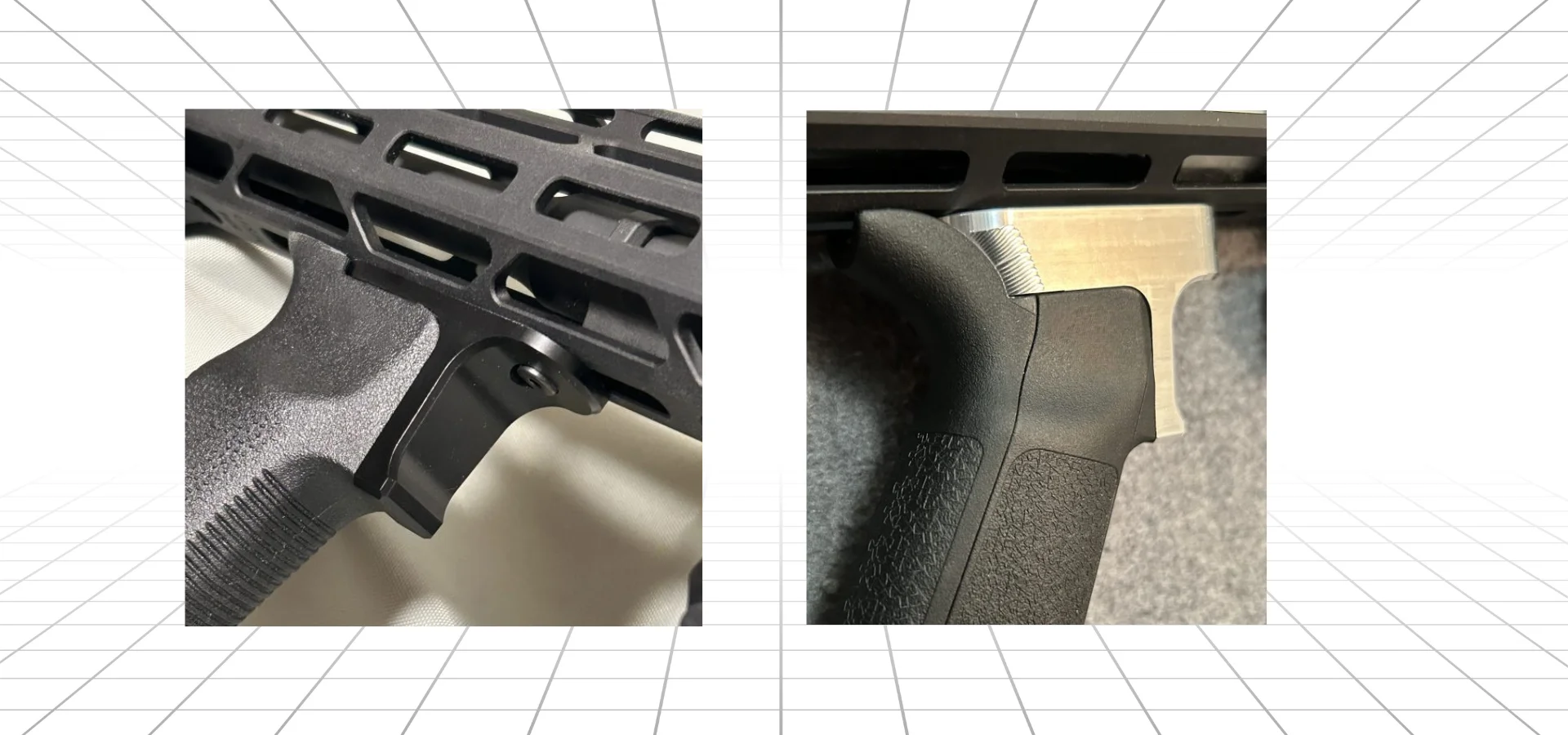
Most AR shooters spend considerable time thinking about their trigger. Pull weight, reset distance, and over travel. All of it matters. But the pistol grip trigger handle relationship is only half the control equation on an AR-platform rifle. The other half is the forend, and for most builds, that half remains unsolved. This blog is about what it actually takes to give both hands a grip worth having.
What is the connection between a pistol grip trigger handle and forend control?
The pistol grip at the rear of an AR-platform firearm is engineered to put the trigger finger in a consistent, natural position for a consistent, repeatable pull. The design is intentional from the grip angle to the palm swell. Every detail of a quality pistol grip exists to serve the dominant hand’s relationship with the trigger.
That same level of intentionality has never been applied to the forend on a standard AR build. The support hand has historically been given a tube, a section of rail, or a polymer foregrip that was bolted on as an afterthought. The result is a bilateral control imbalance that experienced shooters work around through technique rather than through hardware.
Why does the standard AR forend leave the support hand underserved?
The original AR handguard was designed as a heat shield, not a grip interface. As the platform evolved, polymer vertical foregrips entered the market and filled some of the gap. But polymer foregrips are standalone grip accessories with their own grip geometry, which may or may not match the shooter’s dominant hand grip style, and they are mounted to a metal rail through a polymer-to-metal connection that bears torsional and recoil stress on every shot.
The biomechanical research on forearm loading is clear. When the support hand achieves a full-fist vertical wrap at the forend, force transfers along the forearm longitudinal axis rather than across the wrist transverse plane. The wrist fatigues faster under lateral load. A geometry that eliminates that lateral load produces better muzzle control over more rounds. According to the National Shooting Sports Foundation’s training data, ergonomic grip improvements at the forend are among the top cited factors in competitive shooting accuracy gains.
How does the Grip Adapter Device change the forend equation?
The Grip Adapter Device (GAD) from Carbine Leverage Equipment LLC is not a pistol grip. The customer supplies their own standard polymer pistol grip. The GAD is the CNC-machined billet aluminum adapter that takes that grip and seats it onto the fore-end of the handguard rail, giving the support hand the same full-fist geometry the dominant hand already has.
This is a different product category from any standalone foregrip. The GAD does not replace the grip the shooter uses. It extends the grip they already own and are already trained with to the forend position. The connection to the rail is made from CNC billet 6061-T6 aircraft-grade aluminum with Type 2 Hard Black Anodize finish, a surface conversion harder than the base alloy itself. Visit Carbine Leverage Equipment LLC for the full product range.
What should you know about polymer pistol grip attachments?
Every pistol grip currently manufactured is made of polymer plastic. That is true regardless of brand or price point. Polymer serves the grip surface well because texture, shape, and ergonomic feel are what matter at the hand contact interface. These are properties polymer delivers effectively and inexpensively.
The problem is not the polymer grip. The problem is using polymer at the structural connection between that grip and the metal rail. That connection bears mechanical load that polymer handles poorly over time. The GAD solves this by separating the two functions: polymer at the grip surface, aluminum at the rail connection. Each material does the job it is actually suited for.
How do profile heights affect your forend grip setup?
Carbine Leverage Equipment LLC produces the GAD in Low Profile and High Profile heights across both M-LOK and Picatinny platform versions. The LP version is dimensioned for flat-top and square-top pistol grips, placing the hand close to the handguard surface for optimal lever mechanics. The HP version accommodates beaver-tail pistol grips and also accepts flat-top grips for shooters who prefer a higher forend hand position that mirrors the lower receiver grip geometry.
Here is what each configuration delivers:
- LP: minimal hand-to-rail gap, correct fit for flat-top and square-top grip profiles, compact forend profile
- HP: additional vertical clearance for beaver-tail grips, higher hand position option for flat-top grip users
- Both: CNC billet 6061-T6 aluminum, Type 2 Hard Black Anodize, patent-pending design (NPA #18/412,689, USPTO)
- Both: available in M-LOK and Picatinny platform variants with all installation hardware included
- Both: full-fist forend wrap that transfers recoil force along the forearm rather than across the wrist
What does the Polymer pistol grip attachment specifically do at the fore-end?
The Polymer pistol grip attachment in this context refers to the customer’s own polymer pistol grip, which the GAD accepts and connects to the fore-end handguard rail. The GAD itself is not polymer. The adapter body is aluminum. The polymer grip the shooter supplies provides the ergonomic feel. The aluminum GAD provides the structural integrity of the rail connection.
This functional distinction is the core engineering insight behind the product. No polymer foregrip separates these two functions. All of them ask polymer to do both jobs simultaneously. The GAD assigns each job to the right material, and the performance difference over time is significant. For a related discussion, see the published blog on Why Low Profile M-LOK Grip Adapter is Something Worth Investing. For purchasing questions, contact the team at the Carbine Leverage Equipment LLC contact page.
When the Forend Finally Matches the Trigger: The Case for a Real Grip Adapter Setup
The pistol grip trigger handle relationship at the rear of your AR has always worked because the hardware was engineered for it. The forend has never had that same engineering applied, until the GAD. Carbine Leverage Equipment LLC built the adapter that gives the support hand what the dominant hand has had all along: a full-fist grip at a precision-machined, structurally correct connection point. That is not a minor upgrade. It is the ergonomic completion of the AR platform.
Frequently Asked Questions
Q1. Is the pistol grip trigger handle setup related to the Grip Adapter Device?
The GAD completes the bilateral grip system on your AR by giving the support hand a forend grip that mirrors the dominant hand’s trigger grip geometry.
Q2. Does the GAD include a pistol grip?
No. The customer supplies their own polymer pistol grip. The GAD is the aluminum adapter connecting it to the fore-end rail.
Q3. What platform versions are available?
M-LOK and Picatinny, in LP and HP heights.
Q4. What material is the GAD made from?
CNC machined solid billet 6061-T6 aircraft-grade aluminum with Type 2 Hard Black Anodize finish.
Q5. Who can purchase the GAD?
Military, law enforcement, and the general shooting public, through carbineleverageequipmentllc.com.